Why “Office Ecosystem” Became the Defining Concept in Modern Office Design
“Office ecosystem” has become one of the most widely used phrases in post-COVID modern office design and workplace strategy discussions. Real estate firms describe “workspace ecosystems.” Furniture and acoustic booth manufacturers talk about an “ecosystem of work.” Workplace strategists use the term to explain why the office now functions less like a single destination and more like a distributed network of flexible office spaces.
At first glance, it may sound like trend language. But the ecosystem metaphor did not emerge accidentally. It became dominant because the previous metaphor — the office as a machine — no longer explains how modern work environments function.
Understanding the rise of the office ecosystem model helps explain where hybrid workplace solutions, workplace productivity, and office design trends are heading next.
From Machine to Ecosystem: A Shift in Workplace Thinking
For much of the 20th century, the office was described as a machine: predictable, controllable, and optimized from the top down. Inspired by the management principles of Frederick Winslow Taylor, workplaces were designed for supervision, standardization, and measurable efficiency.
This logic shaped fixed desks, rigid schedules, and centralized structures.
The industrial office made sense in a stable economy. But modern organizations behave less like machines and more like complex adaptive systems. Knowledge work evolves quickly. Teams reconfigure. Collaboration happens across time zones. Workplace productivity depends on autonomy, focus, and information flow — not just physical presence.
The ecosystem metaphor captures this complexity more accurately.
Instead of asking:
How do we optimize the office?
It asks:
How do we design environments where people can focus, collaborate, and perform at their best?
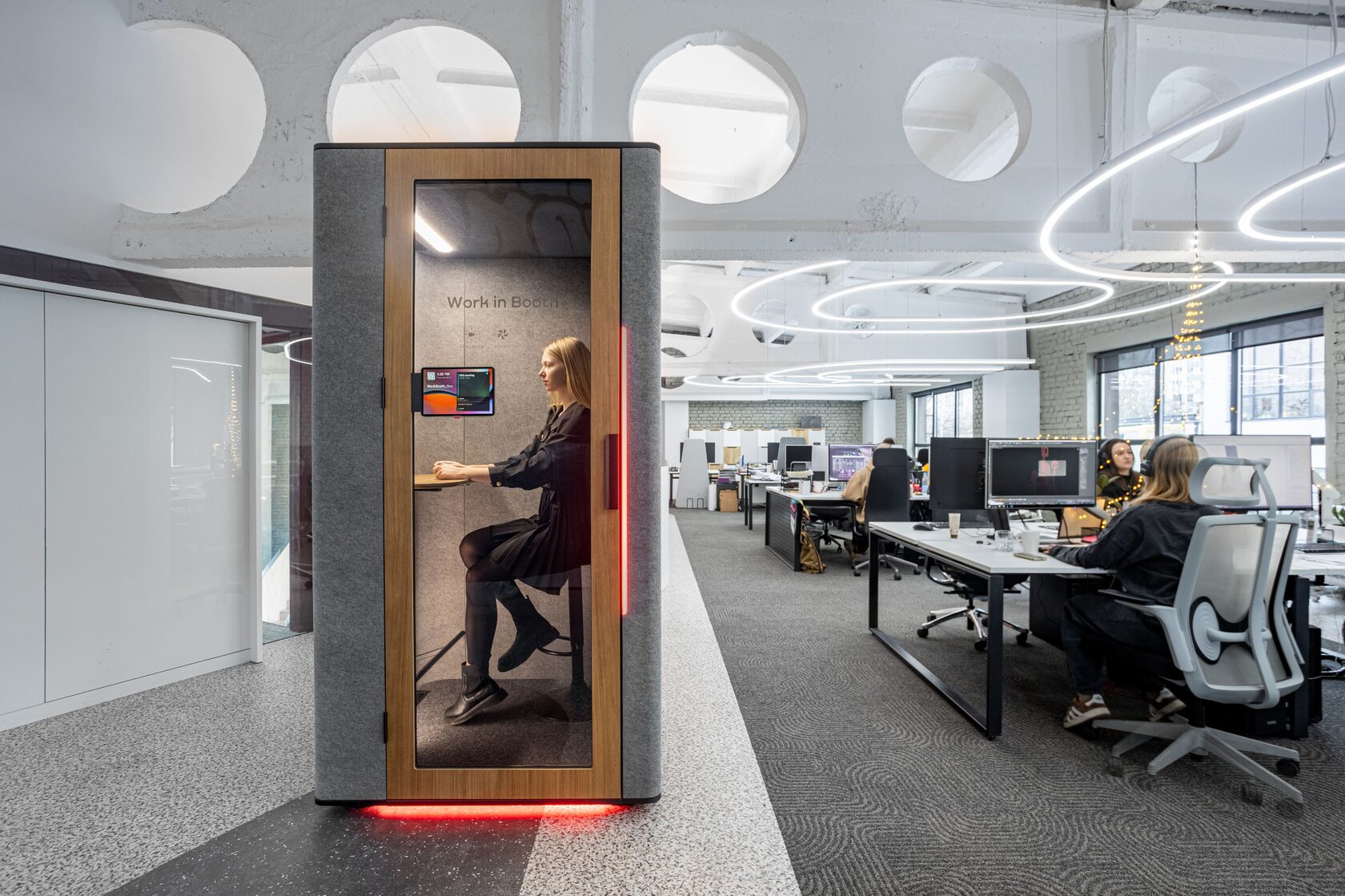
This shift is driving demand for office phone booths, acoustic pods, and adaptable workspace layouts.
The Origins of the Ecosystem Concept
The term “ecosystem” originates outside office design.
In 1930, British botanist Arthur Tansley introduced the concept to describe living communities interacting with environmental conditions over time. The core idea was interdependence and continuous adaptation.
In the 1990s, business strategists adopted the term to describe organizations operating within networks of partners and changing market conditions.
Today, that same logic applies to the workplace.
The modern workplace is not a container—it is an interconnected system of:
- Physical spaces
- Digital tools
- Workplace policies
- Organizational culture
- Human behavior
This interdependence explains why modern office design increasingly combines open collaboration areas with acoustic booths and private focus spaces.
Two Questions That Define the Modern Office Ecosystem
1. Where Do We Work Now?
Hybrid work permanently changed the geography of work.
The office is no longer the sole workplace—it is one node within a distributed network that includes:
- Home offices
- Coworking environments
- Client locations
- Third places (cafés, libraries, shared spaces)
As a result, companies are redesigning offices to become purposeful destinations that support collaboration, creativity, and deep focus work.
This shift has accelerated demand for:
- Office phone booths for calls
- Acoustic pods for concentration
- Flexible and modular layouts
Organizations now prioritize hybrid workplace solutions that improve both employee experience and workplace productivity.
2. How Does Work Fit Into Life Now?
The second transformation is cultural.
Traditional office models often prioritized visibility over outcomes and structure over wellbeing. Hybrid work introduced flexibility—not only in location but also in work rhythms.
Employees increasingly expect:
- Quiet environments for focused tasks
- Reduced noise distractions
- Ergonomic and comfortable spaces
- Technology-enabled autonomy
This is why workplace acoustics has become a core component of modern office design.
Solutions such as acoustic booths and private meeting pods help reduce cognitive load, improve concentration, and support employee wellbeing.
What the Office Ecosystem Model Changes in Workplace Design
The Office Becomes an Anchor — Not the Entire System
In the ecosystem model, the office is no longer the default setting for all work. Instead, it acts as an anchor for collaboration, culture, and alignment.
Design strategies now focus on:
- Experience-driven layouts
- Flexible zones for different work modes
- Private spaces for calls and deep work
This shift explains the rapid global growth of office phone booths and modular acoustic workspace solutions.
Third Places Influence Modern Office Layouts
The ecosystem approach recognizes that work happens beyond corporate offices. Informal environments often inspire design elements such as:
- Lounge-style collaboration zones
- Hospitality-inspired interiors
- Quiet retreat areas
Many organizations now recreate these qualities internally through flexible office spaces and bookable acoustic pods.
Workplace Ecosystems Require Cross-Functional Strategy
A workplace ecosystem is not only about design—it combines:
- HR policies
- Digital infrastructure
- Real estate planning
- Employee experience strategy
Integrated planning ensures that physical environments truly support workplace productivity.
Data Drives Continuous Workplace Improvement
Modern offices increasingly rely on usage insights and behavioral data to optimize space performance.
Understanding how employees use:
- Focus rooms
- Collaboration zones
- Office phone booths
helps organizations refine layouts and improve workplace outcomes over time.
The Deeper Meaning of the Office Ecosystem
An ecosystem evolves continuously.
Unlike traditional office models built for stability, the modern workplace assumes movement:
- People shift between locations
- Teams change collaboration modes
- Organizations adapt quickly to new realities
The future office is not a static floorplan—it is a living system.
And within that system, acoustic booths, private focus spaces, and flexible workplace design play a central role in supporting performance, wellbeing, and adaptability.